
Understanding Why Your Customers Choose You
A Switch interview is a powerful way to understand the reasons why a customer chooses your product or service. This understanding helps you better target your marketing efforts which leads to improved acquisition rates and improve your value proposition, which leads to better activation, retention and referral.
A Switch interview is a powerful way to understand the reasons why a customer chooses your product or service. This understanding helps you better target your marketing efforts which leads to improved acquisition rates and improves your value proposition, which leads to better activation, retention and referral.
The Switch interview works backwards from the moment at which the customer decides to use (or switch to) your product or service all the way through the usual stages of a buying journey, as follows:
- First awareness of the problem and/or solution
- Passively considering alternatives
- Actively considering alternatives
- Deciding between alternatives
- Decision to buy or try your product
Switch and JTBD
The Switch interview has often labelled a jobs to be done interview (JTBD), which can be confusing. I find a useful definition is:
- Switch interview: seeks to answer the questions why and how did a customer come to choose a product and which problem were they trying to solve?
- JTBD interview: seeks to answer the questions what progress is a customer trying to make in their life, how do they measure this progress and what obstacles are preventing them from attaining this progress?
Existing Customer or Not?
Switch interviews are always done with a current customer because they concern a specific product or service. JTBD interviews might be done with a current customer, but are more powerful when done with potential customers, whose answers around the progress they want to make (their jobs) are less likely to be coloured by the product or service we’re investigating.
Four Forces
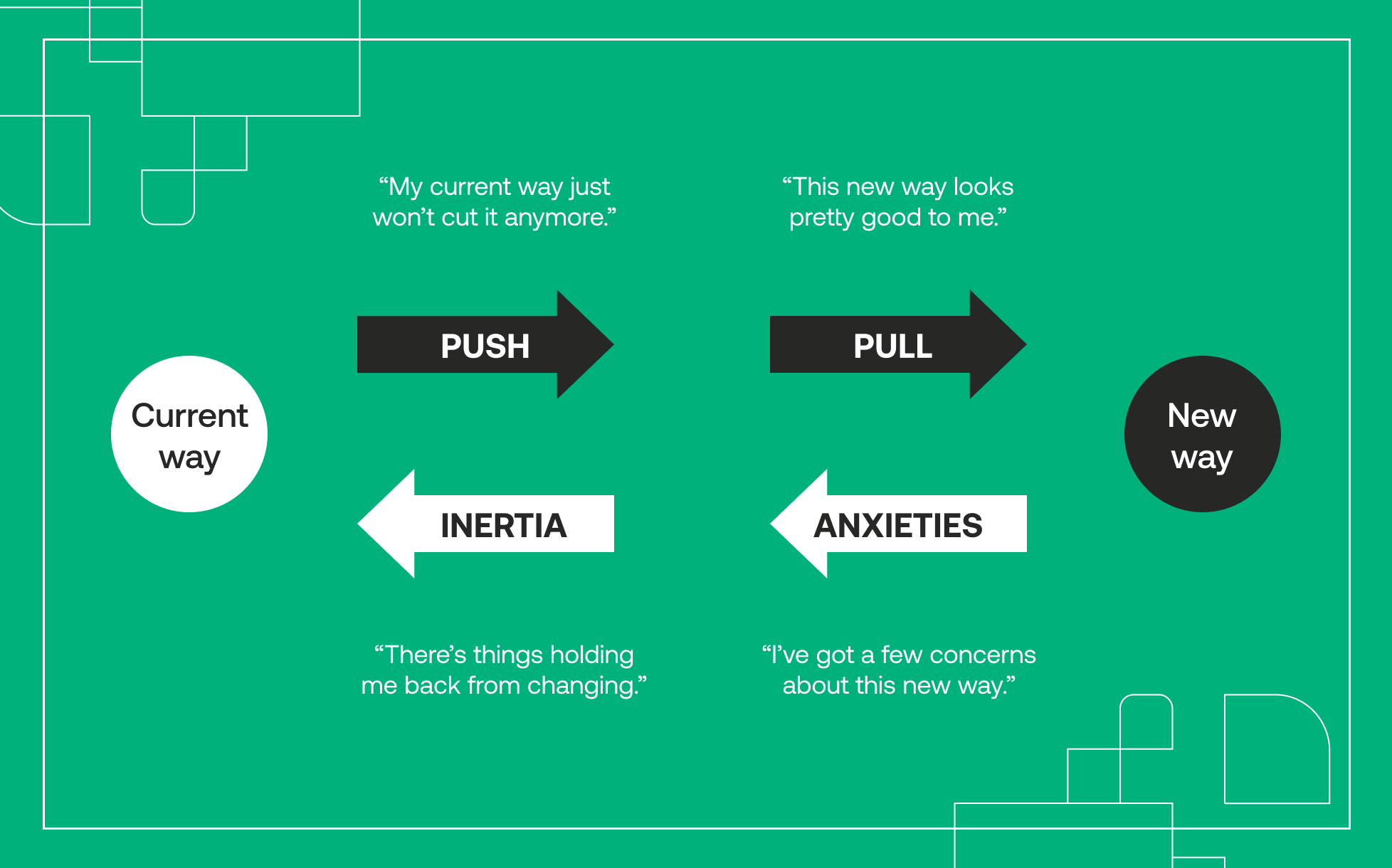
When I run a Switch interview I map responses onto the Four Forces model:
- Problem with the current product or service that leads a consumer to consider a new solution
- Attraction of a new product that pulls them away from their current solution
- Uncertainty about changing keeps the customer using their current solution
- Habits also keep the user from trying a new solution
Sample Questions
I am running Switch interviews this week with customers of the workshops I’ve been doing. My question script is below:
Can you remember the moment at which you decided to attend my event?
- Where were you?
- What were you hoping to get out of the event?
- Did you need to say no to anything in order to attend?
- Did you need approval from anyone to pay?
- How did you get that approval? Was it hard?
- How did you make the decision to attend my event?
- What as difficult about this process?
- What alternatives were you considering?
- What problem did you want those alternatives to solve?
- Before you started considering alternatives, do you remember when you first started to have this problem?
- What did you initially do - in the first instance when you realised you had the problem - to find a solution?
- How did that go? What was hard? What result did you get?
I keep these questions in a Notion page and update them as I go, as I learn which work and which don’t. I use the questions as a rough template, but what I really focus on is the Switch timeline - I want to understand why the customer moved from one step to another.
Good luck, let me know how you get on.
Photo by Victoriano Izquierdo on Unsplash