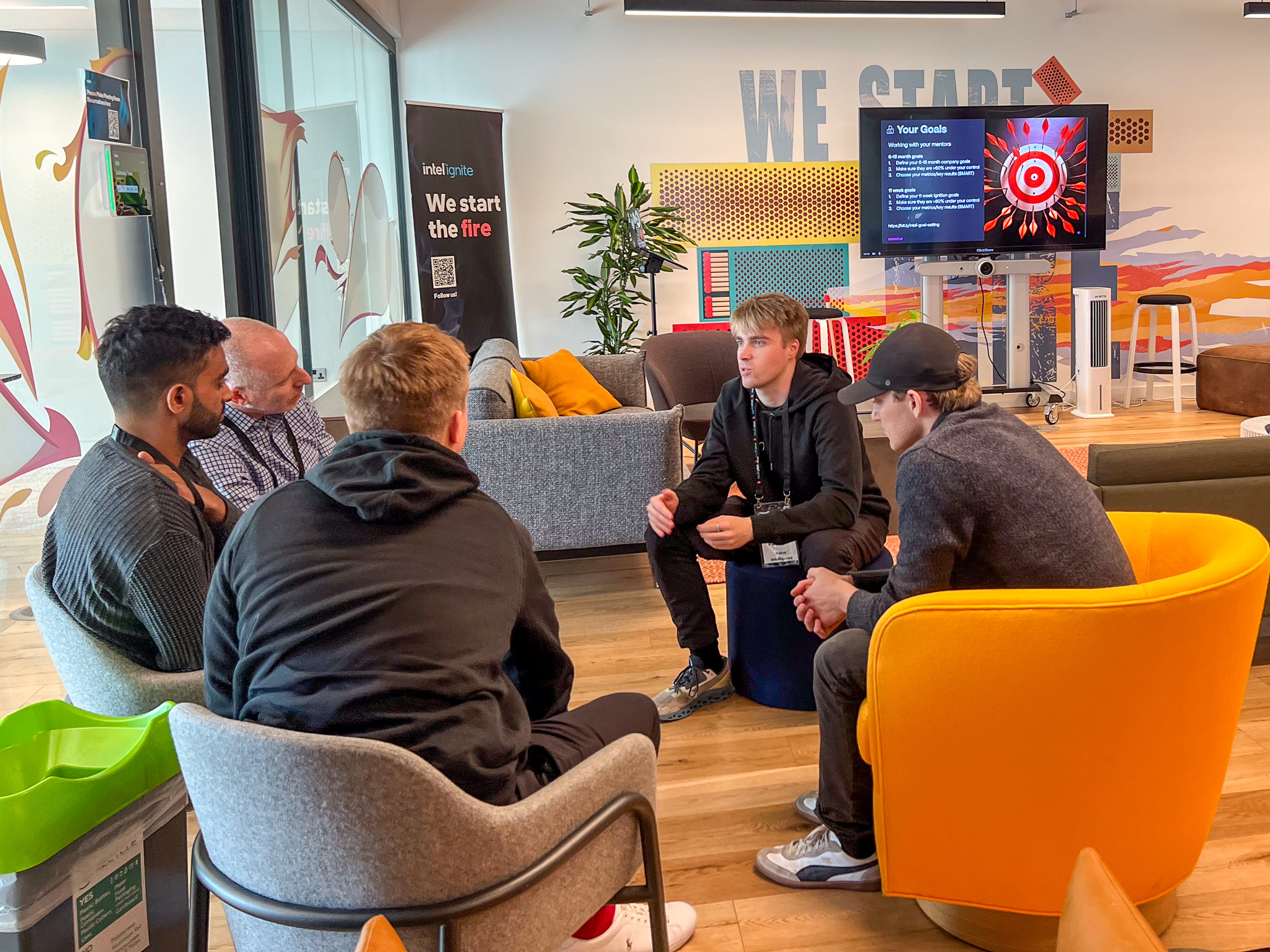
Goal Setting in Deep Tech: From Vague Aspirations to Measurable Momentum
Learn how to set goals that actually work. A practical framework combining OKRs, SMART goals, and confidence assessment to help deep tech founders set achievable targets and rebuild team credibility.
You know you need better goals. You’ve been setting aspirational ones to satisfy investors and your board, but 6 months later you’ve missed most of them.
Now your team is starting to doubt whether the next goal is real or just another moonshot.
Here’s the reality: Goal-setting works, but most founders do it wrong. They set unrealistic targets to impress investors and their team instead of goals they can actually deliver.
Today, I’ll show you a simple framework (OKRs + SMART + control assessment) that helps you set goals you can hit and rebuild credibility with your team.
This isn’t theory—it’s what I use with founders at VECTOR. Here’s how it works.
Want the slides? View the full presentation on Docsend
Why Set Goals?
Goals force you to focus on outcomes, not outputs.
“Close 3 customers” beats “Send 100 emails” every time.
I worked with a founder who set a goal to “improve sales.” Six months later, they’d sent 500 emails, attended 20 conferences, and hired two salespeople. But they still had zero customers. When we reframed the goal to “Close 3 customers in the healthcare ICP by Q2,” everything changed. They stopped the email blasts, focused on 10 healthcare companies, and closed 3 deals.
That’s the power of outcome-focused goals. They develop clarity of thinking by making you define what success actually looks like. When you know your goal, you can make tough decisions and say no to distractions. Research consistently shows that setting specific goals increases achievement.
The OKR Framework
Understanding Goals vs Key Results
A Goal (Objective) is an outcome you want to achieve. “Close first customer” is a goal. It’s inspiring, qualitative, and outcome-focused.
Key Results are the metrics that indicate you’ve achieved the goal. For that same goal, your key results might be:
-
Identify ideal customer profile (Feb)
-
Qualify 5 opportunities in the ICP (Apr)
-
Close one opportunity in the ICP (Jul)
Notice how each key result is specific, measurable, and time-bound (SMART).
Want to dive deeper? Check out Measure What Matters by John Doerr, the definitive guide to OKRs.
The Structure That Works
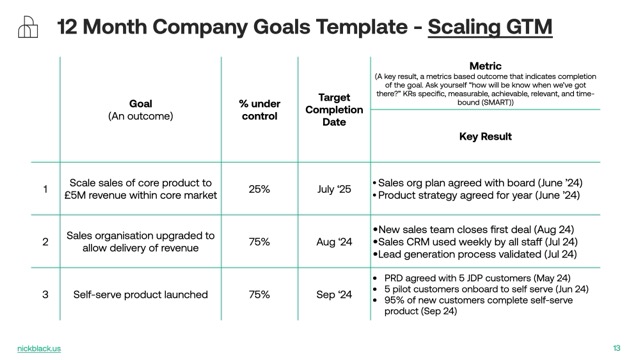
Here’s the template I use with founders:
Goal: [Outcome you want]
-
% under control:
[How much you can influence] -
Target completion date:
[When] -
Key Results (3-5 SMART metrics):
a.
[Specific, measurable, time-bound]b.
[Specific, measurable, time-bound]c.
[Specific, measurable, time-bound]
Two Time Horizons
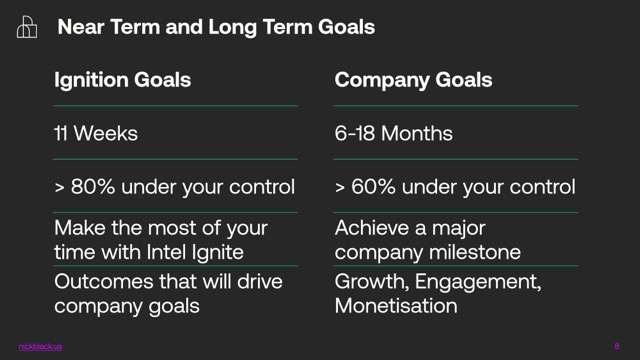
Near-Term Goals (11 Weeks)
Set goals for 11 weeks (or 3 months) where you’re >80% confident you can deliver. Why 80%? Below that threshold, you’re gambling with your credibility. Choose goals that raise your probability of hitting the end goal.
These should focus on actions you can take RIGHT NOW. For example: “Identify ideal customer profile” with key results like:
-
Talk to 20 potential customers (Month 1)
-
Analyze patterns (Month 2)
-
Define ICP (Month 3)
Long-Term Goals (6-18 Months)
For longer timeframes, aim for >60% control. The extended timeline allows for some external dependencies, but you still drive the outcome. These goals should target major company milestones.
Example: “Close first customer” with key results:
-
Identify ICP (Feb)
-
Qualify 5 opportunities (Apr)
-
Close one (Jul)
How to Set Goals - Step by Step
Step 1: Define Your Goal (The Outcome)
Ask yourself: What outcome do I want to achieve? Why does this matter? What will be different when I achieve it?
Good goal: “Close first customer” (outcome)
Bad goal: “Send more emails” (output)
Step 2: Assess Confidence (Can You Deliver?)
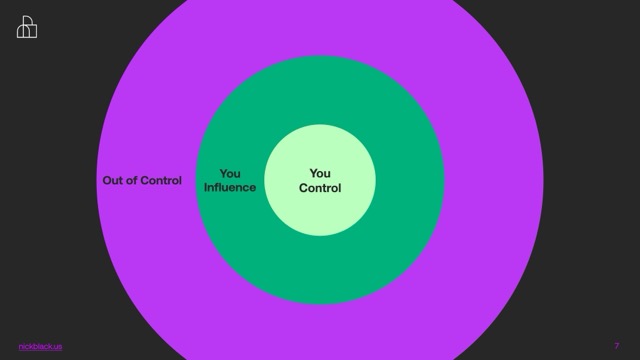
This is where most founders fail. Ask yourself:
-
Am I >80% confident I can hit this goal?
-
What parts can I directly influence?
-
What requires external approval or action?
-
What could go wrong?
Below 80% confidence, you’re setting yourself up to fail. Here’s the difference:
-
Low confidence: “Close customer by March” (30% confidence—customer controls timeline)
-
Higher confidence: “Do everything in my power to close by March” (80% confidence—you control your actions: send proposal, follow up, address objections)
Step 3: Set Key Results (SMART)
Each Key Result must be:
-
Specific: “Identify ideal customer profile” not “find customers”
-
Measurable: “5 opportunities” not “some opportunities”
-
Achievable: Based on your current resources and constraints
-
Relevant: Directly contributes to the goal
-
Time-bound: “By Feb” not “soon”
Step 4: Choose Your Metrics
At 1-3 customers, focus on FIT:
-
Sales with growth potential
-
Example: “3 customers in same ICP who renew and expand”
At 10+ customers, focus on GROWTH:
-
Customer engagement, retention, renewal and upsell
-
Example: “>80% renewal rate, >30% expansion rate”
Common Mistakes
Mistake 1: Goals That Are Too Vague
Bad: “Get more customers” (Your team has no idea what to prioritize)
Good: “Close 3 customers in the same ICP by end of Q2” (Everyone knows exactly what success looks like)
Fix: Use SMART framework for key results
Mistake 2: Goals With Low Confidence (<80%)
Bad: “Close customer by March” (30% confidence—customer controls timeline, you’re gambling)
Good: “Do everything in my power to close by March” (80% confidence—you control your actions)
Fix: Choose goals that raise your probability of hitting the end goal
Mistake 3: Too Many Goals
Bad: 10 goals at once (Your team is scattered, nothing gets done)
Good: 2-3 major goals, each with 3-5 key results (Clear focus, measurable progress)
Fix: Focus on what matters most
Mistake 4: Not Reviewing Progress
Bad: Set goals in January, check in December (By then, it’s too late to course-correct)
Good: Monthly reviews—what’s working? What needs to change? (You catch problems early and adjust)
Fix: Goals are tools, not contracts. Adjust as you learn.
The Framework in Action
Here’s what this looks like for a pre-PMF deep tech startup:
Goal: Close first customer
-
% under control: 50%
-
Target: July
-
Key Results:
a. Identify ideal customer profile (Feb)
b. Qualify 5 opportunities in the ICP (Apr)
c. Close one opportunity in the ICP (Jul)
Key Takeaways
-
Goals focus on outcomes, not outputs: “Close 3 customers” not “Send 100 emails”
-
Use OKRs: Goals (outcomes) + Key Results (SMART metrics)
-
Confidence matters: >80% confident for 11-week goals, >60% for 6-18 month goals. Below 80%, you’re setting yourself up to fail—choose a goal that raises your probability
-
SMART key results: Specific, Measurable, Achievable, Relevant, Time-bound
-
Review monthly: Goals are tools, adjust as you learn
Next Steps
Use the template to set 2-3 goals. Review monthly, adjust as needed. Remember: Goals are tools, not contracts.
The difference between founders who scale and those who stall? The ones who scale know exactly what they’re aiming for—and whether they’re hitting it.
If you’re struggling to set goals that actually work, let’s talk. At VECTOR, we help deep tech founders build repeatable GTM engines by focusing on what actually moves the needle.