
Why Narrowing Your Focus Accelerates Your Sales
Learn why focusing on one customer segment accelerates sales faster than chasing multiple segments. Geoffrey Moore's Crossing the Chasm advice from 1991 still works today. Here's why.
The Problem: Too Many Segments Kill Growth
80% of pre-Series A deep tech founders I meet through VECTOR are sabotaging their growth by chasing too many customer segments.
They think more segments = more revenue, less risk, more defensibility. They’re wrong.
Every new segment you chase dilutes your product, confuses your messaging, and kills your word-of-mouth growth. I see this pattern destroy promising companies every day.
The irony? Investors push for higher ARR, but their pressure to “expand your TAM” actually slows revenue growth.
The Solution: Focus on One Beachhead
Geoffrey Moore nailed this problem in his 1991 Crossing the Chasm. His advice from 33 years ago still works:
-
Focus on one customer segment (he called it a beachhead)
-
Dominate the segment and then expand to the next
-
Do not set expansive sales goals until you have truly secured the beachhead
Why Focus Works: Word of Mouth Requires Reference Groups
-
Word of mouth is the best way of marketing a product
-
It only works if you’re selling to customers who will reference each other
-
That means being willing to give and receive a reference
-
So if you sell to Pharma one week and Industry the next, the Industry buyer isn’t going to care what the Pharma buyer says.
The Modern Application: Your ICP Should Be Narrower
Nowadays we call Moore’s beachhead an Ideal Customer Profile (ICP).
This is why founders focusing too broadly on their ICP see slower sales, hampered revenue growth, and feature bloat that reduces value delivery.
Want to find product-market fit faster? Try narrowing your target market (ICP or Beachhead) even further.
Moore’s Original Insight
Moore explained it perfectly:
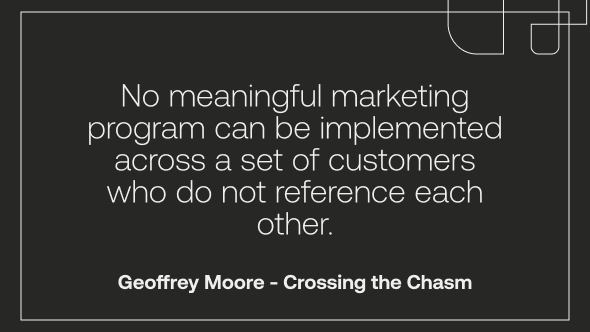
“Marketing professionals insist on market segmentation because they know no meaningful marketing program can be implemented across a set of customers who do not reference each other. The reason for this is simply leverage. No company can afford to pay for every marketing contact made. Every program must rely on some ongoing chain-reaction effects—what is usually called word of mouth. The more self-referencing the market and the more tightly bounded its communications channels, the greater the opportunity for such effects.”
How We Help: Focus Your GTM at VECTOR
At VECTOR, we select 5 deep tech companies each year and embed experienced operators who kill 80% of your initiatives in week one. The 20% that remain? Those actually move the needle. In 6 months, you’ll have 10 real customers in one focused segment, not 50 pilots across five industries that never convert.
If you’re drowning in conflicting advice while your runway burns, let’s talk. We’ll show you how to turn your scattered sales efforts into a repeatable GTM engine that works.